The Calm Kit
What to Say (and Never Say) During a Meltdown, at Any Age
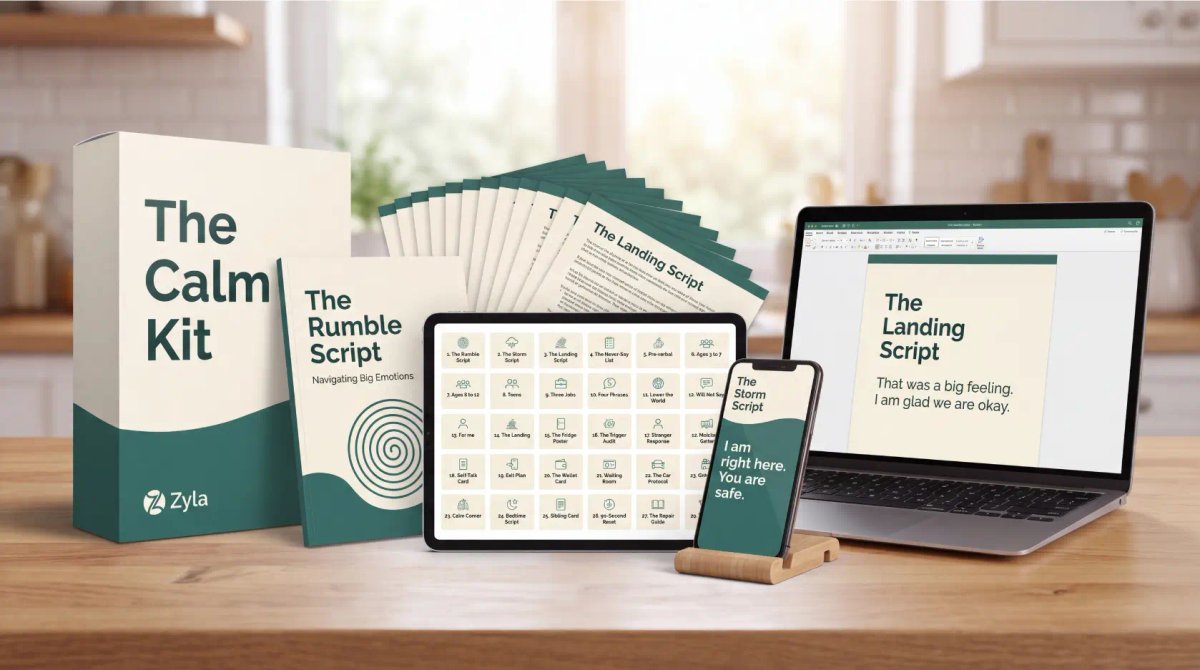
Twenty-seven printable tools that put the right words in your hand during the storm.
Print tonight. Use tonight. No diagnosis required.
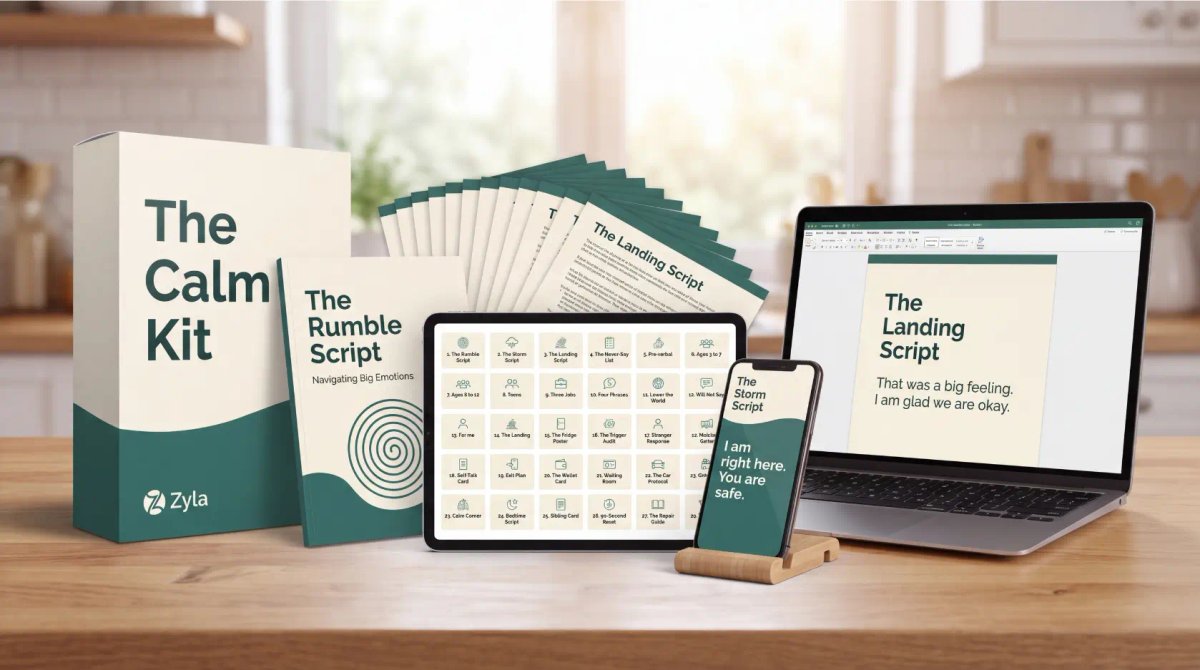
Twenty-seven printable tools that put the right words in your hand during the storm.
Print tonight. Use tonight. No diagnosis required.
You have read the articles. You have tried the tips. You have stayed calm, held the boundary, used the timer, praised the good moments. And at 5:15 on a Tuesday, in the hallway, none of it was in your hand.
Here is the thing nobody says plainly. There is no magic phrase that ends a meltdown. A meltdown is not a tantrum. Your child has not decided to do this and cannot decide to stop. It is a loss of control, a defence against too much at once, and it runs its course.
But there are words that help and words that make it worse. In the build-up. At the peak. In the comedown. Nobody taught us which is which. So we say the thing that feels natural, "calm down," "use your words," "look at me," and the storm gets bigger, and we do not know why.
The Calm Kit is the which-is-which. Twenty-seven single pages. One page per moment. Written from what autistic adults describe from inside a meltdown, and from what parents actually say worked, then rebuilt for every age from pre-verbal to teenager.
It does not promise to stop the storms. Fewer and shorter is the honest promise. And the right words, tonight, is the immediate one.
Picture it: the rumble starts, and instead of searching your memory for something that might work, you glance at the card on the fridge and say the line.
You have read the articles.
You have tried the tips.
You have stayed calm, held the boundary, used the timer, praised the good moment.
And at 5:15 on a Tuesday, in the hallway, none of it was in your hand.
Here is the thing nobody says plainly.
There is no magic phrase that ends a meltdown.
A meltdown is not a tantrum.
Your child has not decided to do this and cannot decide to stop.
It is a loss of control, a defence against too much at once, and it runs its course.
But there are words that help and words that make it worse.
In the build-up. At the peak. In the comedown. Nobody taught us which is which
So we say the thing that feels natural, "calm down," "use your words," "look at me," and the storm gets bigger, and we do not know why.
The Calm Kit is the which-is-which. Twenty-seven single pages. One page per moment.
Written from what autistic adults describe from inside a meltdown, and from what parents actually say worked, then rebuilt for every age from pre-verbal to teenager.
It does not promise to stop the storms. Fewer and shorter is the honest promise. And the right words, tonight, is the immediate one.
Picture it: the rumble starts, and instead of searching your memory for something that might work, you glance at the card on the fridge and say the line.
no diagnosis
no waiting list
no therapist appointment
no course to finish
no app to learn
no book to read at 11pm
no perfect calm voice
no household that agrees with you
One page per moment. Print the ones you need. Put them where the storms happen: the fridge, the car, your wallet.
That is the whole method. It is faster than anything you have tried because it is not something you have to remember. It is something you can hold.
no diagnosis
no waiting list
no therapist appointment
no course to finish
no app to learn
no book to read at 11pm
no perfect calm voice
no household that agrees with you
One page per moment. Print the ones you need. Put them where the storms happen: the fridge, the car, your wallet.
That is the whole method. It is faster than anything you have tried because it is not something you have to remember. It is something you can hold.
A meltdown is a loss of control, not a choice.
The National Autistic Society describes a meltdown as an intense response to an overwhelming situation in which a person temporarily loses control of their behaviour, and states plainly that it is not bad or naughty behaviour.
Source: National Autistic Society, Meltdowns: a guide for all audiences
The wrong response raises the temperature.
In a study of toddlers, mothers' controlling responses such as scolding and physical restraint were associated with more emotional arousal and poorer physiological regulation in the child. A later study across Germany and Chile found that restrictive control built on punishment and compliance without reasoning was linked to anger-driven ways of handling emotion in childhood. Neither study was limited to autistic children.
Sources: Calkins, Smith, Gill and Johnson (1998), Social Development; Weis et al. (2016), reported in Current Psychology systematic review (2022)
Strategies in hand beat information alone.
In the largest trial of its kind, published in JAMA, parents given specific in-the-moment strategies saw their children's disruptive behaviour fall by 47.7 percent over 24 weeks, against 31.8 percent for parents given the same amount of time in education about the condition with no strategies. Both groups learned. The group with tools in hand did better.
Source: Bearss et al., Effect of Parent Training vs Parent Education on Behavioral Problems in Children With Autism Spectrum Disorder, JAMA, 2015
This is not only an autism story.
Emotional dysregulation is estimated to affect between 25 and 45 percent of children with ADHD, and the mechanics of overwhelm, fight-or-flight and loss of control are the same nervous system whatever the label, or with no label at all.
Source: Shaw, Stringaris, Nigg and Leibenluft, Emotion Dysregulation in Attention Deficit Hyperactivity Disorder, American Journal of Psychiatry, 2014
The Calm Kit exists for the storm that is happening tonight. It does not replace assessment or therapy, and it does not ask what your child has been called by anyone. It is what you use in the hallway at 5pm.
A meltdown is a loss of control, not a choice.
The National Autistic Society describes a meltdown as an intense response to an overwhelming situation in which a person temporarily loses control of their behaviour, and states plainly that it is not bad or naughty behaviour.
Source: National Autistic Society, Meltdowns: a guide for all audiences
The wrong response raises the temperature.
In a study of toddlers, mothers' controlling responses such as scolding and physical restraint were associated with more emotional arousal and poorer physiological regulation in the child. A later study across Germany and Chile found that restrictive control built on punishment and compliance without reasoning was linked to anger-driven ways of handling emotion in childhood. Neither study was limited to autistic children.
Sources: Calkins, Smith, Gill and Johnson (1998), Social Development; Weis et al. (2016), reported in Current Psychology systematic review (2022)
Strategies in hand beat information alone.
In the largest trial of its kind, published in JAMA, parents given specific in-the-moment strategies saw their children's disruptive behaviour fall by 47.7 percent over 24 weeks, against 31.8 percent for parents given the same amount of time in education about the condition with no strategies. Both groups learned. The group with tools in hand did better.
Source: Bearss et al., Effect of Parent Training vs Parent Education on Behavioral Problems in Children With Autism Spectrum Disorder, JAMA, 2015
This is not only an autism story.
Emotional dysregulation is estimated to affect between 25 and 45 percent of children with ADHD, and the mechanics of overwhelm, fight-or-flight and loss of control are the same nervous system whatever the label, or with no label at all.
Source: Shaw, Stringaris, Nigg and Leibenluft, Emotion Dysregulation in Attention Deficit Hyperactivity Disorder, American Journal of Psychiatry, 2014
The Calm Kit exists for the storm that is happening tonight. It does not replace assessment or therapy, and it does not ask what your child has been called by anyone. It is what you use in the hallway at 5pm.
The rumble starts at the door.
You say "we need to go now." It builds. You say "please, not today."
It peaks. You say "calm down," because what else is there.
Twenty minutes later everyone is wrecked, you are late, and you replay it in the car wondering what you should have said.
The rumble starts at the door.
You pull the Rumble Script from your wallet and use the two lines that lower the demand instead of raising it.
If it peaks anyway, the Storm Script gives you the few words that do not pour fuel on it, and the Never-Say List keeps the wrong ones out of your mouth.
When it lands, the Landing Script gives you the reconnection before any lesson.
You are still late.
But the storm was shorter, nobody said the thing that makes it worse, and the Repair Guide gives you five minutes tonight that turn it into a skill instead of a scar.
The rumble starts at the door.
You say "we need to go now." It builds. You say "please, not today."
It peaks. You say "calm down," because what else is there.
Twenty minutes later everyone is wrecked, you are late, and you replay it in the car wondering what you should have said.
The rumble starts at the door.
You pull the Rumble Script from your wallet and use the two lines that lower the demand instead of raising it.
If it peaks anyway, the Storm Script gives you the few words that do not pour fuel on it, and the Never-Say List keeps the wrong ones out of your mouth.
When it lands, the Landing Script gives you the reconnection before any lesson.
You are still late.
But the storm was shorter, nobody said the thing that makes it worse, and the Repair Guide gives you five minutes tonight that turn it into a skill instead of a scar.

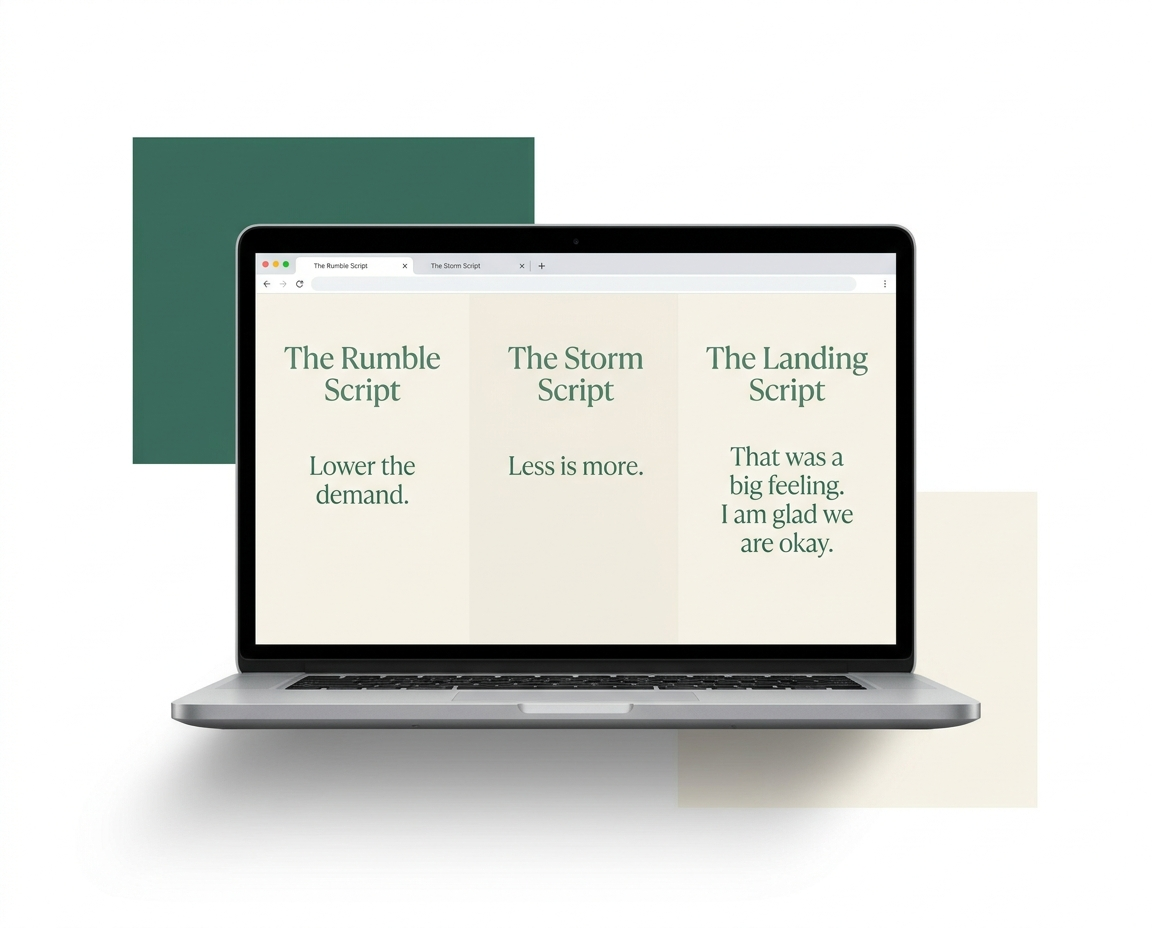
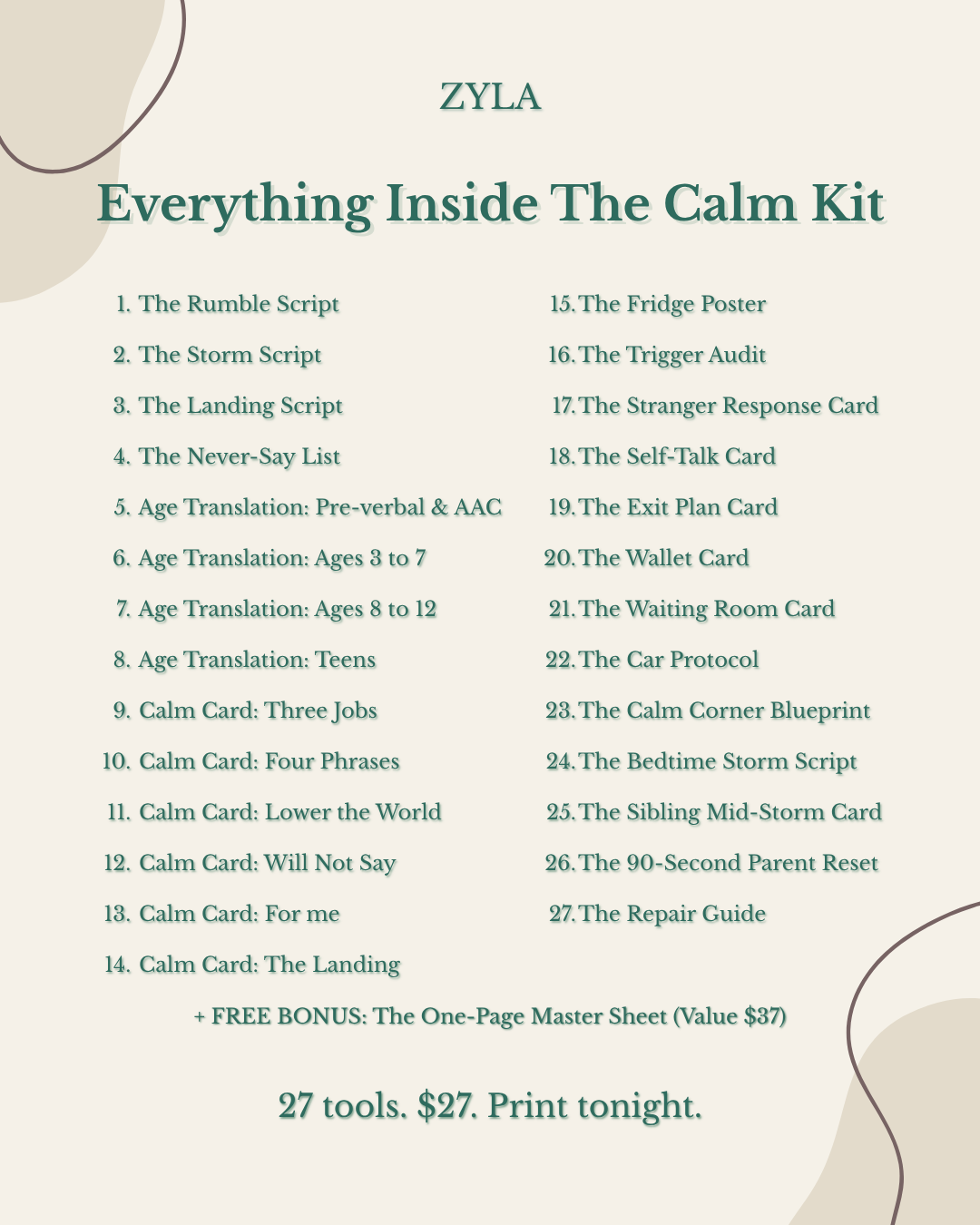
The Rumble Script. What to say when you see it coming, so the storm shrinks instead of builds. (Most meltdowns are lost in the ninety seconds before they start, and this is the page for those ninety seconds.)
The Storm Script. The few words that help at the peak, when almost everything makes it worse. (You will recognise at least one phrase you have been saying that belongs on the next list instead.)
The Landing Script. Reconnection words for the comedown, before any lesson. (The lesson delivered here is the one that never lands. The reconnection delivered here is the one that prevents the next storm.)
The Never-Say List. The phrases that backfire in each phase, and why, so nobody in the house says them again. (Grandparents included. Stick it to the fridge and let the fridge have the argument.)
Age Translation: Pre-verbal & AAC. The scripts rebuilt for children with few or no words, including AAC users. (The standard advice assumes a child who can answer you. This does not.)
Age Translation: Ages 3 to 7. Six-word sentences and shown choices for the youngest storms. (Long sentences are a demand. Six words is the ceiling.)
Age Translation: Ages 8 to 12. Respectful de-escalation for kids who know exactly what a meltdown is. (And who will hear condescension from across the room.)
Age Translation: Teens. Privacy-first scripts, including the text message version. (Because the door is shut, and the text is the only script that gets through it.)
The Six Calm-Down Cards. One card per hard moment for the fridge, the car, and your wallet, so you remember one card instead of a book. (Three Jobs, Four Phrases, Lower the World, Will Not Say, For Me, The Landing.)
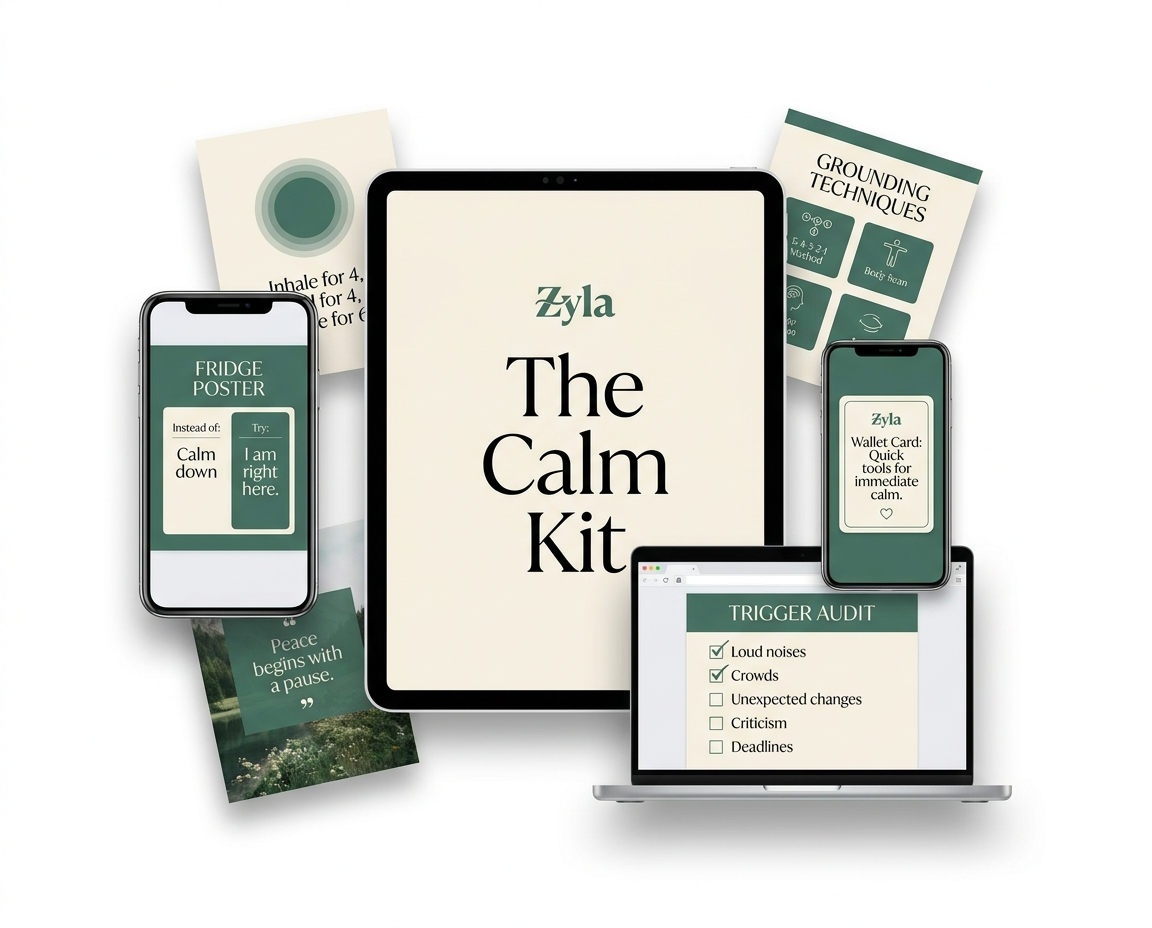
The Fridge Poster. Say this, not this, do this, at kitchen height for the whole household. (The version of the method your partner will actually read.)
The Trigger Audit. Ninety seconds after each incident reveals the pattern behind the random meltdowns. (Two weeks of this and anything and everything sets him off starts to become a list of five things.)
The Stranger Response Card. The one calm line for the person who comments. (Written for the parent who should not have to explain anything and is too tired to fight about it.)
The Self-Talk Card. What to say to yourself under the stares. (The stares are the second meltdown in the room. This is the script for that one.)
The Exit Plan Card. The pre-decided exit that turns leaving into strategy, not defeat. (Decided on a calm day, so nobody has to decide it in the queue.)
The Wallet Card. Hand it over, end the interaction, return to your child. (Ends the conversation with the stranger in one motion.)
The Waiting Room Card. Appointments, restaurants, and lines: the slow-burn public plan. (For the meltdown that takes forty minutes to arrive and everyone can see coming.)
The Car Protocol. The pull-over sequence, the two phrases, and the seat-pocket kit list. (The one place you cannot leave the room.)
The Calm Corner Blueprint. Build the home calm space that works, with the one rule that keeps it from becoming punishment. (Break the rule and the corner becomes the naughty step with cushions.)
The Bedtime Storm Script. Evening dysregulation, de-escalated without losing the destination. (Written for the child who holds it together all day at school and releases it all at 7:40pm.)
The Sibling Mid-Storm Card. A job and an exit for brothers and sisters, agreed on a calm day. (The sibling who has a job is not the sibling who gets hurt or forgotten.)
The 90-Second Parent Reset. Feet, breath, words, hands: regulation that fits inside the storm itself. (Not self-care. Capacity. When you are dysregulated your child will be too.)
The Repair Guide. The five-minute conversation that turns hard moments into connection and skills. (The part everyone skips because everyone is exhausted, and the part that changes the next storm.)
Every tool is one page. Every page tells you what it is and what it does in the moment. Nothing to read at midnight, nothing to finish first. It works for autistic kids, ADHD kids, differently wired kids, and kids with no diagnosis at all, from the pre-verbal years through the slam-the-door years. If the storms are part of your family's life, this was built for you.


The storm itself
The Rumble Script. What to say when you see it coming, so the storm shrinks instead of builds. (Most meltdowns are lost in the ninety seconds before they start, and this is the page for those ninety seconds.)
The Storm Script. The few words that help at the peak, when almost everything makes it worse. (You will recognise at least one phrase you have been saying that belongs on the next list instead.)
The Landing Script. Reconnection words for the comedown, before any lesson. (The lesson delivered here is the one that never lands. The reconnection delivered here is the one that prevents the next storm.)
The Never-Say List. The phrases that backfire in each phase, and why, so nobody in the house says them again. (Grandparents included. Stick it to the fridge and let the fridge have the argument.)
Age Translation: Pre-verbal & AAC. The scripts rebuilt for children with few or no words, including AAC users. (The standard advice assumes a child who can answer you. This does not.)
Age Translation: Ages 3 to 7. Six-word sentences and shown choices for the youngest storms. (Long sentences are a demand. Six words is the ceiling.)
Age Translation: Ages 8 to 12. Respectful de-escalation for kids who know exactly what a meltdown is. (And who will hear condescension from across the room.)
Age Translation: Teens. Privacy-first scripts, including the text message version. (Because the door is shut, and the text is the only script that gets through it.)
The Six Calm-Down Cards. One card per hard moment for the fridge, the car, and your wallet, so you remember one card instead of a book. (Three Jobs, Four Phrases, Lower the World, Will Not Say, For Me, The Landing.)
The Fridge Poster. Say this, not this, do this, at kitchen height for the whole household. (The version of the method your partner will actually read.)
The Trigger Audit. Ninety seconds after each incident reveals the pattern behind the random meltdowns. (Two weeks of this and anything and everything sets him off starts to become a list of five things.)
The Stranger Response Card. The one calm line for the person who comments. (Written for the parent who should not have to explain anything and is too tired to fight about it.)
The Self-Talk Card. What to say to yourself under the stares. (The stares are the second meltdown in the room. This is the script for that one.)
The Exit Plan Card. The pre-decided exit that turns leaving into strategy, not defeat. (Decided on a calm day, so nobody has to decide it in the queue.)
The Wallet Card. Hand it over, end the interaction, return to your child. (Ends the conversation with the stranger in one motion.)
The Waiting Room Card. Appointments, restaurants, and lines: the slow-burn public plan. (For the meltdown that takes forty minutes to arrive and everyone can see coming.)
The Car Protocol. The pull-over sequence, the two phrases, and the seat-pocket kit list. (The one place you cannot leave the room.)
The Calm Corner Blueprint. Build the home calm space that works, with the one rule that keeps it from becoming punishment. (Break the rule and the corner becomes the naughty step with cushions.)
The Bedtime Storm Script. Evening dysregulation, de-escalated without losing the destination. (Written for the child who holds it together all day at school and releases it all at 7:40pm.)
The Sibling Mid-Storm Card. A job and an exit for brothers and sisters, agreed on a calm day. (The sibling who has a job is not the sibling who gets hurt or forgotten.)
The 90-Second Parent Reset. Feet, breath, words, hands: regulation that fits inside the storm itself. (Not self-care. Capacity. When you are dysregulated your child will be too.)
The Repair Guide. The five-minute conversation that turns hard moments into connection and skills. (The part everyone skips because everyone is exhausted, and the part that changes the next storm.)
Every tool is one page. Every page tells you what it is and what it does in the moment. Nothing to read at midnight, nothing to finish first.
It works for autistic kids, ADHD kids, differently wired kids, and kids with no diagnosis at all, from the pre-verbal years through the slam-the-door years. If the storms are part of your family's life, this was built for you.

Twenty-seven tools. Twenty-seven dollars. A dollar a tool. Less than one co-pay.
The One-Page Master Sheet: the whole system on a single printable page.
Standalone value $37 FREE*
Every phase, every phrase, every never-say, on one page for the fridge. (This is the page you will photograph and keep on your phone, because the storm does not always happen near the fridge.)
*Included free with every Calm Kit purchase.
The One-Page Master Sheet: the whole system on a single printable page.
Standalone value $37 FREE*
Every phase, every phrase, every never-say, on one page for the fridge. (This is the page you will photograph and keep on your phone, because the storm does not always happen near the fridge.)
*Included free with every Calm Kit purchase.
Is this therapy?
No, and it is not pretending to be. The Calm Kit is educational and organisational: scripts, cards, and worksheets that tell you what to say and where to put it. It does not assess, diagnose, or treat anything. If your child has a therapist, this is what you use in the hallway between appointments, which is where most of the storms happen.
Is it instant?
he download is instant. The change is not, and anyone who tells you otherwise has not lived in your house. What is instant is having the right words in your hand tonight instead of searching for them. The pattern work in the Trigger Audit takes two weeks. The scripts work the first time you use them, because they replace the phrases that were making it worse.
My child has no diagnosis. Will it fit?
Yes. The tools work on the moment, not the label. Tools 5 to 8 adapt every script from pre-verbal through teens, and nothing in the kit asks what your child has been called by anyone. If you are on a waiting list and were told there is nothing to do while you wait, this is something to do while you wait.
I have read everything already. What is different about this?
You are not short of advice. You are short of something that works at 5pm on a Tuesday. Everything you have read was written to be read. This was written to be held: one page, one moment, on the fridge or in your wallet. The difference is not the insight. It is the format.
Is this therapy?
No, and it is not pretending to be.
The Calm Kit is educational and organisational: scripts, cards, and worksheets that tell you what to say and where to put it. It does not assess, diagnose, or treat anything.
If your child has a therapist, this is what you use in the hallway between appointments, which is where most of the storms happen.
Is it instant?
he download is instant
The change is not, and anyone who tells you otherwise has not lived in your house.
What is instant is having the right words in your hand tonight instead of searching for them.
The pattern work in the Trigger Audit takes two weeks. The scripts work the first time you use them, because they replace the phrases that were making it worse.
My child has no diagnosis. Will it fit?
Yes. The tools work on the moment, not the label. Tools 5 to 8 adapt every script from pre-verbal through teens, and nothing in the kit asks what your child has been called by anyone.
If you are on a waiting list and were told there is nothing to do while you wait, this is something to do while you wait.
I have read everything already. What is different about this?
You are not short of advice.
You are short of something that works at 5pm on a Tuesday.
Everything you have read was written to be read. This was written to be held: one page, one moment, on the fridge or in your wallet.
The difference is not the insight. It is the format.
The Calm Kit provides educational and organisational tools only and is not medical, psychological, or therapeutic advice.
Privacy Policy · Terms · Refund Policy · Contact
© 2026 Zyla. All rights reserved.
This site is not part of the Facebook website or Facebook Inc. Additionally, this site is not endorsed by Facebook in any way. FACEBOOK is a trademark of FACEBOOK, Inc.
The Calm Kit provides educational and organisational tools only and is not medical, psychological, or therapeutic advice.
Privacy Policy · Terms · Refund Policy · Contact
© 2026 Zyla. All rights reserved.
This site is not part of the Facebook website or Facebook Inc. Additionally, this site is not endorsed by Facebook in any way. FACEBOOK is a trademark of FACEBOOK, Inc.